Sales funnel
From the first message to the order: the sales funnel in Instagram DMs
Some stores treat Instagram DMs as just an inbox. But in reality, many customers decide, ask questions, ask for the price, and place the order inside the same conversation.
If DMs are only for receiving messages, sales leak away. DM sales mean you have a clear path: welcome, understand the need, present the product, remove objections, and close the order.
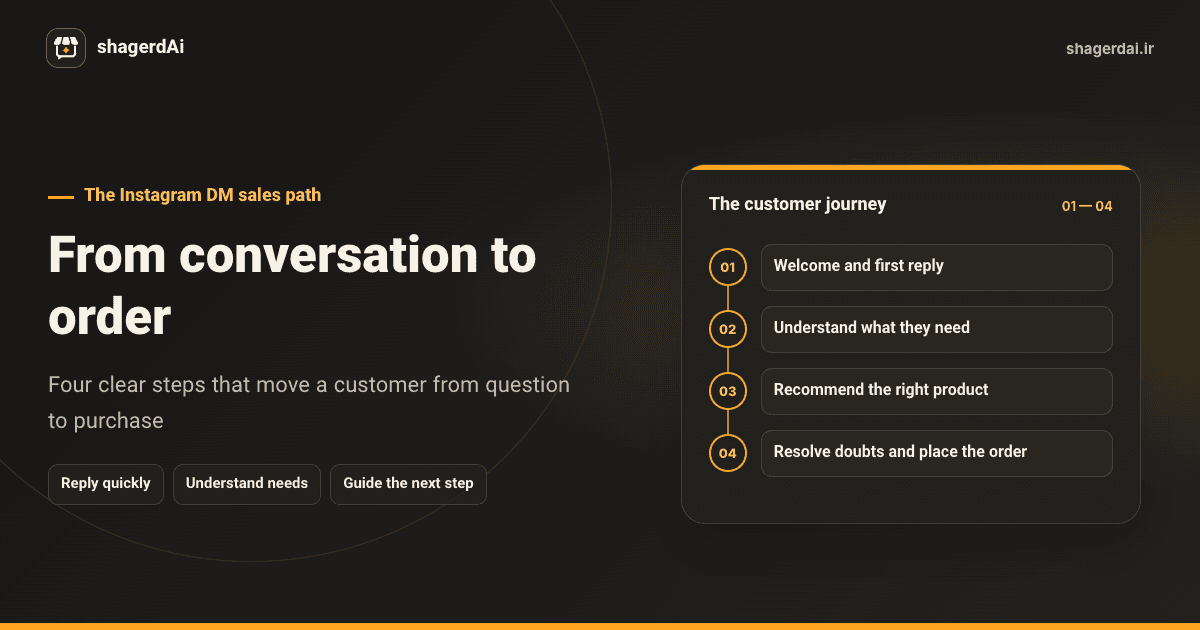
DM is not only for replies; it is also for conversion
On Instagram, customers expect a fast, clear, reassuring reply. If the first message is only “hi” and then no real need is answered, the sale stalls or goes to a competitor.
In a sales flow, DMs do three jobs: attract attention, reduce uncertainty, and simplify the decision. If you combine all three, your sales become repeatable instead of relying on chance.
A 5-step sales path in DMs
1. Welcome and quick recognition
The first message should make the customer feel that the page is active and ready to help. A short and friendly sentence is enough.
2. Understand the real need
Instead of pushing the product immediately, ask what matters to them: size, color, use case, delivery time, or conditions.
3. Present the product and value
Show the product with the right value point. If you have a website, send the exact product link and, when needed, show the cart.
4. Remove uncertainty
Make pricing, shipping, returns, guarantees, and delivery time clear. Most customer hesitations disappear when risk is reduced.
5. Final offer and order collection
The next step must be clear: do you want to order now, ask for more details, or visit the catalog?
Three common DM sales patterns
Some stores start with a question-driven sales approach, some with product presentation, and some with follow-up after the first interaction. All can work, but they must match the customer's intent.
If the customer is new, the first message must clarify the product difference. If they already asked a repeated question, give a short, clear answer. If they are close to a decision, give one stronger next step: order, contact support, or visit the site.
Question-led pattern
You start by asking what the customer needs. This is ideal for stores with many product types.
Product-led pattern
You present one item with the main benefit. Ideal for stores with a narrow product line or one clear hero product.
Follow-up pattern
If a customer asked before and did not decide, send a short reminder with clear next steps.
Mistakes that kill sales
Too little information
If your answer is just “yes, it's available,” the customer will leave quickly. Give them enough to decide.
No next step
After answering, the customer should know the next action: product link, order, call, or follow-up.
Ignoring price and shipping
If you do not clarify shipping, delivery time, or return conditions, a simple question turns into friction.
Relying on a single message
Many sales happen in the second or third message. A good conversation often needs 3 to 5 messages.
What should you measure?
If DMs are genuinely creating sales, you need to measure. If you only answer messages without tracking conversion, you will not know the weak point.
Three important numbers matter: response time, product-link click rate, and order or contact rate. If you check these weekly, you can improve the path quickly.
Response time
The faster you answer, the more likely the customer is to continue.
Product-link click rate
Track how many conversations click the product or cart link.
Order or contact rate
Finally, estimate how many conversations become an order or a final call.
7 days to build a DM sales path
Day 1: review the last 20 messages
See what people are asking and which questions repeat most often.
Day 2: standardize repeated replies
Write ready-made answers for address, shipping, delivery time, and product intro.
Day 3: organize product links and carts
Give real product links from your catalog, not just a phone number.
Day 4: define human-only rules
Which questions should go to the admin, and which can be answered automatically?
Day 5: write sales-first messages
Create short but complete messages for three repeat scenarios.
Day 6: track the numbers
Track response time, links sent, and orders weekly.
Day 7: improve the path
Review your best and worst messages and focus on what actually converts.
Q&A
Should the DM itself place the order?
No. The DM should simplify the sales path, but the final order and payment should happen through your main channel: the website, cart, or WhatsApp.
How fast should we reply?
The faster, the better. But the real priority is giving the right answer that moves the customer toward a purchase.
What if the customer stalls in the DM?
Give them a single clear next step: the product link, price, delivery time, or contact with the admin.
Turn DMs into a real sales path from today
Standardize repeated replies, clarify the buying path, and invest only in what actually creates sales.